AI Writing Tools

Explore the best AI Writing Tools — independent reviews, comparisons, pricing and step-by-step how-to guides, curated by Aizhi.

  • Springpad

    Springpad

    Springpad was a free online application and web service that allowed its registered users to save, organize and share collected ideas and information. As users added content to their Springpad accounts, the application automatically identified and categorized it, then generated additional snippets based on the types of objects added—for example, listing price comparisons for products and showtimes for movies. Springpad was also available as apps on the iPad, iPhone and Android that synchronized with the Web interface. Springpad was bundled on new Toshiba notebook computers through a Web application subscription service. On May 23, 2014, Springpad announced that it would cease operations on June 25, 2014. The company then allowed users to export their data (as JSON and read-only HTML formats), or to automatically migrate it to Evernote accounts before the expiration date. == Features == Springpad users could use the main site interface which uses HTML5 from most browsers or use the smartphone app to capture notes, tasks, or lists which were then added to the user's "My Stuff", the user's personal database or collection. Additionally Springpad let users look up items of interest which were then automatically categorized based on type or manually categorized by the user. Category types included recipes, movies, products, restaurants and wine. Events could also be added to Springpad, and if the user used Google Calendar, they could opt to sync the event to it. In addition to the smartphone app and site, Springpad could be used via browser extension for Google Chrome, or the Springpad Clipper, a bookmarklet to analyze webpages and clip relevant information from them—for example, the ingredients needed for a recipe—or to add the site as a normal bookmark. Another way users could add content to their Springpad "My Stuff" was by emailing entries to an email address specified on Springpad registration. Springpad's smartphone apps could be used to scan barcodes to identify products, save them to the user's "My Stuff", and automatically generate additional product information and links. The mobile app could also save images taken with the phone's camera, and locate nearby businesses. With most of the content added to a user's "My Stuff", relevant news, useful links and other helpful information could be viewed. Users could also attach additional notes and images to content they had already saved, and could add reminders and alerts which could be emailed to the user or texted to their phone. Springpad also added alerts to its own Alerts section for relevant news, deals or coupons for specific products users added. For additional organization, anything added to Springpad could also be tagged. Users could also add entries to "Notebooks" to separate content by projects, or any other way they wished. Each Notebook included a section called a "Board", which acted as a pin board where users could "pin" content they'd added to the Notebook, allowing them to visually lay out items. If the user added a map to the Board and had entries that included an address, Springpad could automatically point out entries on the map. By default, everything added to Springpad was private. However users could change the privacy settings for each of the types of items added, decide to make specific items public and shareable on Facebook and Twitter, add them to their public page, or keep them private but links to them with specific people.

    Read more →
  • Kai's Power Tools

    Kai's Power Tools

    Kai's Power Tools (KPT) are a set of API plugins created by the German computer scientist Kai Krause in 1992 that were designed for use with Adobe Photoshop and Corel Photo-Paint. Kai's Power Tools were sold to Corel in 2000 when MetaCreations was closed. There are various versions of Kai's Power Tools. KPT 3, 5, 6, and X sets are compilations of different filters. The program interface features a reward-based function in which a bonus function is revealed as the user moves towards more complex aspects of the tool. == Filters == The KPT Convolver is a mathematics based filter; the level of precision and varying effects can be achieved by using numerical values of colour, tint, hue, saturation, contrast, brightness, luminosity, and posterize. The KPT Projector takes the current image or selection and offers a number of interactive perspective warp effects. To a large extent, with its draggable distortion handles and its moving, scaling and rotating options, this simply duplicates Adobe Photoshop's Free Transform capabilities. What is completely different is the ability to rotate the bitmap image in 3D space and to tile the results if desired. It can also animate the distortions by dragging keyframes from the preview window into an animation palette. KPT 6 will then preview the animation and output it to various sizes in avi or mov format. This animation capability is even more useful with the KPT Turbulence filter. This is another distortion filter, but one that treats the image as if it was completely liquid. The preview panel shows the animation in real time. The KPT Goo filter is used to produce a single frame freeform liquid distortion. This filter is available both with KPT 6 and the standalone version. It works by effectively turning a bitmap image into a liquid that can be interactively smeared, smudged, twirled, and pinched with the range of tools on offer. The obvious use is to distort photographic portraits into caricatures. KPT Materializer can create advanced surface textures based on bump maps that define troughs and peaks. It can use any external image for the basis of the bump map or alternatively the user can pick out the hue, saturation, luminance or red, green, or blue channel of the current image. It can then offset, scale and rotate the texture map, control its lighting, and even blend in a reflection map. The filter can be used for anything from providing an oil-painting feel to an entire image, to giving the illusion of depth to a selection. Also producing the impression of depth is the KPT Gel filter which uses various paint tools to synthesize photo-realistic 3D materials such as metals, liquids, or plastics. Gel painting is very different from traditional 2D painting as the brush strokes pool together when they touch and refract the underlying image. It can also manipulate 3D paint—once it has been added—by twirling, pinching, and carving it. The opposite is true of the Equalizer filter, which is used for applying variations on sharpening effects. The filter has three modes. The first mode, Equalizer, looks and works rather like the graphic equalizer on a stereo system, enabling adjustment of the level of pixel contrast within nine bands of different visual frequencies. The second mode, Contrast Sharpen, allows for increasing the contrast between light and dark areas in an image. The third mode, Bounded Sharpen, can sharpen an image without causing oversharpening, which can lead to halo effects. This feature is particularly useful when pulling out the detail in an image softened by resizing. KPT SceneBuilder is used for producing photorealistic 3D scenes by importing and rendering 3DS files. The main image window offers three tabs for editing in 2D and 3D mode and for setting up the object's final texture. Many users regard this filter as being the most impressive because it acts as a standalone 3D rendering tool and provides control over everything from transparency, reflection, refraction, bump mapping through to multiple light sources, and so on but without the ability to create or edit objects. The final filter, KPT SkyEffects, also has its roots in Metacreations' experience with 3D programs such as Bryce and RayDream. This filter is designed to simulate the interaction between the light from the sun or moon with no less than six atmospheric layers of haze, fog and cloud. The filter is typical of the KPT 6 collection as a whole: at times the interface is inspired and offers the ability to create beautiful reddening sunsets simply by interactively dragging the sun toward the horizon, producing realistic sunsets and moonscapes. == Other effects == Kai's Power Tools 6 features a lens flare effect for precisely managing the type of glow, halo, streaks, and reflection. The addition of a library of preset effects helps to overcome this by allowing the user to choose a standard effect and then interactively position the flare in the image preview. KPT 6 provides a new engine in the form of the KPT Reaction, which takes a reaction seed and turns it into a seamlessly tiling pattern based on a reaction diffusion process. It offers random noise, regular dots or reticulated voronoi patterns or a bitmap image itself as the seed. Corel has no plans for any updates.

    Read more →
  • PNGOUT

    PNGOUT

    PNGOUT is a freeware command line optimizer for PNG images written by Ken Silverman. The transformation is lossless, meaning that the resulting image is visually identical to the source image. According to its author, this program can often get higher compression than other optimizers by 5–10%. It is possible to compress some inflated PNGs to a size below 1% of the original file. PNGOUT was also available as a plug-in for the freeware image viewer IrfanView and can be enabled as an option when saving files. It allows editing of various PNGOUT settings via a dialog box. PNGOUT integration was removed in IrfanView version 4.58 in favour of OptiPNG. In 2006, a commercial version of PNGOUT with a graphical user interface, known as PNGOUTWin, was released by Ardfry Imaging, a small company Silverman co-founded in 2005. There is also a freeware GUI frontend to PNGOUT available, known as PNGGauntlet. == Main operation == The main function of PNGOUT is to reduce the size of image data contained in the IDAT chunk. This chunk is compressed using the deflate algorithm. Deflate algorithms can vary in speed and compression ratio, with higher compression ratios generally implying lower speed. Ken Silverman wrote a deflate compressor for PNGOUT that is slower than the ones used in most graphics software, but produces smaller files. PNGOUT also performs automatic bit depth, color, and palette reduction where appropriate.

    Read more →
  • Image warping

    Image warping

    Image warping is the process of digitally manipulating an image such that any shapes portrayed in the image have been significantly distorted. Warping may be used for correcting image distortion as well as for creative purposes (e.g., morphing). The same techniques are equally applicable to video. While an image can be transformed in various ways, pure warping means that points are mapped to points without changing the colors. This can be based mathematically on any function from (part of) the plane to the plane. If the function is injective the original can be reconstructed. If the function is a bijection any image can be inversely transformed. Some methods are: Images may be distorted through simulation of optical aberrations. Images may be viewed as if they had been projected onto a curved or mirrored surface. (This is often seen in ray traced images.) Images can be partitioned into image polygons and each polygon distorted. Images can be distorted using morphing. The most obvious approach to transforming a digital image is the forward mapping. This applies the transform directly to the source image, typically generating unevenly-spaced points that will then be interpolated to generate the required regularly-spaced pixels. However, for injective transforms reverse mapping is also available. This applies the inverse transform to the target pixels to find the unevenly-spaced locations in the source image that contribute to them. Estimating them from source image pixels will require interpolation of the source image. To work out what kind of warping has taken place between consecutive images, one can use optical flow estimation techniques. == Image warping toolbox == ImWIP is an open-source, image warping tool for modeling deformation and motion in digital images, which contains differentiable image warping operators, together with their exact adjoints and derivatives.

    Read more →
  • Meta-Labeling

    Meta-Labeling

    Meta-labeling, also known as corrective AI, is a machine learning (ML) technique utilized in quantitative finance to enhance the performance of investment and trading strategies, developed in 2017 by Marcos López de Prado at Guggenheim Partners and Cornell University. The core idea is to separate the decision of trade direction (side) from the decision of trade sizing, addressing the inefficiencies of simultaneously learning both side and size predictions. The side decision involves forecasting market movements (long, short, neutral), while the size decision focuses on risk management and profitability. It serves as a secondary decision-making layer that evaluates the signals generated by a primary predictive model. By assessing the confidence and likely profitability of those signals, meta-labeling allows investors and algorithms to dynamically size positions and suppress false positives. == Motivation == Meta-labeling is designed to improve precision without sacrificing recall. As noted by López de Prado, attempting to model both the direction and the magnitude of a trade using a single algorithm can result in poor generalization. By separating these tasks, meta-labeling enables greater flexibility and robustness: Enhances control over capital allocation. Reduces overfitting by limiting model complexity. Allows the use of interpretability tools and tailored thresholds to manage risk. Enables dynamic trade suppression in unfavorable regimes. == Applications == Meta-labeling has been applied in a variety of financial ML contexts, including: Algorithmic trading: Filtering and sizing trades to reduce false positives. Portfolio optimization: Scaling exposure across multiple signals with differing confidence levels. Risk management: Dynamically disabling strategies in adverse market conditions. Model validation: Interpreting when and why a model may be underperforming due to regime shifts. == General architecture == Meta-labeling decouples two core components of systematic trading strategies: directional prediction and position sizing. The process involves training a primary model to generate trade signals (e.g., buy, sell, or hold) and then training a secondary model to determine whether each signal is likely to lead to a profitable trade. The second model outputs a probability that is interpreted as the confidence in the forecast, which can be used to adjust the position size or to filter out unreliable trades. Meta-labeling is typically implemented as a three-stage process: Primary model (M1): Predicts the direction or label of a financial outcome using features such as market prices, returns, or volatility indicators. A typical output is directional, e.g., Y ∈ {−1,0,1}, representing short, neutral, or long positions. Secondary model (M2): A binary classifier trained to predict whether the primary model's prediction will be profitable. The target variable is a binary meta-label F ∈ { 0 , 1 } {\displaystyle F\in \{0,1\}} . Inputs can include features used in the primary model, performance diagnostics, or market regime data. Position sizing algorithm (M3): Translates the output probability of the secondary model into a position size. Higher confidence scores result in larger allocations, while lower confidence leads to reduced or zero exposure. === Stage 1: Forecasting side === Primary model architecture Figure 1 Figure 1 presents the architecture of a primary model. It focuses on forecasting the side of the trade. Following the example, this model (M1) takes in input data – such as open-high-low-close data and determines the side of the position to take: a negative number is a short position, and positive number is a long position, the range is set between −1 and 1 (the closer it is to −1 or 1, the stronger the models conviction is). When training the model, the labels are −1 and 1, based on the direction of forward returns for some predefined investment horizon. The researcher may decide to apply a recall check (τ: "Tau") by setting a minimum threshold that the initial output needs to be to qualify of a short or long position (if the threshold is not met, no side forecast is predicted, leading to closing of any open positions), this leads to the primary model output which is one of three possible side forecasts: −1, 0, or 1. The primary model also generates evaluation data which can be used by the secondary model, to improve performance of size forecasts. Some examples of evaluation data include rolling accuracy, F1, recall, precision, and AUC scores. === Stage 2: Filtering out false positives === General meta-labeling architecture Figure 2 Next comes the phase of filtering out false positives, by applying a secondary machine learning model (M2), which is a binary classifier trained to determine if the trade will be profitable or not. The model takes as input four general groupings of data: General input data which is predictive of a false positive. For example the last 30 days rolling volatility of the underlying asset. Evaluation data. Market state and regime data, one may find that macro economic data or clustering the market into regimes may help as specific trading strategies are known to perform better in particular regimes. Example: momentum based strategies perform best in periods with low volatility and strong directional moves. Primary models initial input which is a value between −1 and 1. This highlights the strength of the primary models conviction. The output of the model is a value between −1 and 1 (if using a Tanh function) which will indicate the strength of the conviction that a short or long position is profitable, or it could simply be between 0 and 1 (using a sigmoid function) if one only wanted to know if it made money or not. This output allows filtering out trades that are likely to lead to losses. One could stop at this point or use the outputs of the secondary model as inputs to a position sizing algorithm (M3) which could further enhance strategy performance metrics by translating the output probability of the secondary model into a position size. Higher confidence scores result in larger allocations, while lower confidence leads to reduced or zero exposure. === Stage 3: Optimizing position sizes === ==== Position sizing methods (M3) ==== Various algorithms have been proposed for transforming predicted probabilities into trade sizes: All-or-nothing: Allocate 100% of capital if the probability exceeds a predefined threshold (e.g., 0.5); otherwise, do not trade. Model confidence: Use the probability score directly as the fraction of capital allocated. Linear scaling: Rescale the model's probabilities using min-max normalization based on the training data. Normal CDF (NCDF): Use a normal cumulative distribution function applied to a z-statistic derived from the predicted probability. Empirical CDF (ECDF): Rank probabilities based on their percentile in the training data to ensure relative allocation. Sigmoid Optimal Position Sizing (SOPS): Applies a smooth non-linear sigmoid transformation optimized to maximize risk-adjusted returns (Sharpe ratio). ==== Model calibration ==== Each machine learning algorithm used in meta-labeling tends to produce outputs with different characteristic distributions; for example, some are approximately normally distributed, whereas others exhibit a pronounced U-shape, concentrating probabilities near the extremes. Due to these varying distributions, simply summing the outputs of different models can inadvertently lead to uneven weighting of signals, biasing trade decisions. To address this, model calibration techniques are essential to adjust the predicted probabilities towards frequentist probabilities, ensuring that model outputs reflect true likelihoods more accurately. Two common calibration techniques are: Platt scaling (Sigmoid scaling): Suitable for correcting S-shaped calibration plots typically produced by models such as support vector machines (SVMs). Isotonic regression: Fits a non-decreasing step function to probabilities and is effective particularly with larger datasets, though it can sometimes lead to overfitting. Transforming predictions to frequentist probabilities is crucial as it provides probabilistic outputs that are directly interpretable as the actual likelihood of an event occurring. Such calibration significantly enhances the effectiveness of fixed position sizing methods, reducing maximum drawdowns and increasing risk-adjusted returns. However, calibration has less impact on position sizing methods that directly estimate parameters from the training data, such as ECDF and SOPS, suggesting that calibration is a critical step mainly for fixed methods that rely heavily on raw model outputs. =

    Read more →
  • Automated restaurant

    Automated restaurant

    An automated restaurant or robotic restaurant is a restaurant that uses robots to do tasks such as delivering food and drink to the tables or cooking the food. Restaurant automation means the use of a restaurant management system to automate some or occasionally all of the major operations of a restaurant establishment. More recently, restaurants are opening that have completely or partially automated their services. These may include: taking orders, preparing food, serving, and billing. A few fully automated restaurants operate without any human intervention whatsoever. Robots are designed to help and sometimes replace human labour (such as waiters and chefs). The automation of restaurants may also allow for the option for greater customization of an order. == History == === Vending machines === In the late 19th and early 20th century a number of restaurants served food solely through vending machines. These restaurants were called automats or, in Japan, shokkenki. Customers ordered their food directly through the machines. === Sushi conveyors === Yoshiaki Shiraishi is a Japanese innovator who is known for the creation of conveyor belt sushi. He had the idea following difficulty staffing his small sushi restaurant and managing the restaurant on his own. He was inspired seeing beer bottles on a conveyor belt in an Asahi brewery. Yoshiaki's restaurants are an early example of restaurant automation; they used a conveyor belt to distribute dishes around the restaurant, eliminating the need for waiters. This example of automation dates back to the Japanese economic miracle; the first of Yoshiaki's conveyor belt sushi restaurants was opened under the name Mawaru Genroku Sushi in 1958, in Osaka. === Partial automation === As of 2011, across Europe, McDonald's had already begun implementing 7,000 touch screen kiosks that could handle cashiering duties. From 2015 to 2020, Zume had an automated pizza parlor. Later companies would try to produce smaller, less ambitious devices, with one robotics company producing a machine that could automate the slowest and most repetitive parts of assembling a pizza, such as spreading pizza sauce or placing slices of pepperoni, while leaving other customizations to employees. In 2020, a restaurant in the Netherlands began trialling the use of a robot to serve guests. In September 2021, Karakuri's 'Semblr' food service robot served personalised lunches for the 4,000 employees of grocery technology solutions provider ocado Group's head offices in Hatfield, UK. 2,700 different combinations of dishes were on offer. Customers could specify in grams what hot and cold items, proteins, sauces and fresh toppings they wanted. In 2021, Columbia University School of Engineering and Applied Science engineers developed a method of cooking 3D printed chicken with software-controlled robotic lasers. The “Digital Food” team exposed raw 3D printed chicken structures to both blue and infrared light. They then assessed the cooking depth, colour development, moisture retention and flavour differences of the laser-cooked 3D printed samples in comparison to stove-cooked meat. In June 2022 a California nonprofit chain of residential communities, Front Porch, experimented with robots in dining rooms at two locations to supplement wait staff by carrying plated food and drink to tables, and removing dishes. 65% of residents found the robots helpful, with 51% saying they let the staff spend more quality time with diners. 51% of staff were "excited" and 58% said they enabled more quality time with diners. The chain has 19 senior living communities (and 35 affordable housing communities), so it has potential to expand robots to more dining rooms. It is shifting to memory care, which may affect plans. == Rationales == === Advantages === Efficiency: Automated restaurants can significantly enhance operational efficiency by minimizing human error and reducing service time. With automated ordering, payment, and food preparation systems, customers can enjoy faster service and reduced waiting times. Cost savings: By reducing the need for human staff, automated restaurants can potentially lower labor costs. This can be particularly beneficial in areas with high labor expenses, as it allows for better resource allocation and cost management. Consistency: Automation ensures consistency in food quality and presentation. With precise portion control and standardized cooking methods, customers can expect the same quality and taste in their meals every time they visit. Enhanced customer experience: Self-service kiosks and automated systems provide customers with control and convenience. They can customize their orders, browse through menu options, and pay seamlessly, creating a more interactive and satisfying dining experience. === Disadvantages === Lack of personal touch: Automated restaurants may lack the personal interaction and warmth that traditional restaurants provide. Some customers prefer the human touch, personalized recommendations, and the social aspect of dining out. Technical issues: Reliance on technology means that technical glitches and malfunctions can occur, resulting in service disruptions or delays. Maintenance and technical support become critical in ensuring smooth operations. Limited menu complexity: The automation process may be better suited for standardized menu items rather than complex or customized dishes. The ability to cater to unique dietary preferences or accommodate special requests may be limited. Employment implications: Automated restaurants may result in job losses for traditional restaurant staff, potentially impacting the local workforce. It is important to consider the social and economic implications of adopting such technology. == Locations == Automated restaurants have been opening in many countries. Examples include: Nala Restaurant in Naperville, Illinois Fritz's Railroad Restaurant in Kansas City, Kansas Výtopna, a Railway Restaurant using model trains: franchise of various restaurants and coffeehouses in the Czech Republic Bagger's Restaurant in Nuremberg, Germany FuA-Men Restaurant, a ramen restaurant located in Nagoya, Japan Fōster Nutrition in Buenos Aires, Argentina Dalu Robot Restaurant in Jinan, China Haohai Robot Restaurant in Harbin, China Robot Kitchen Restaurant in Hong Kong Robo-Chef restaurant in Tehran, Iran, started in 2017, is the first robotic and "waiterless" restaurant of the Middle East. MIT graduates opened Spyce Kitchens in downtown Boston, Massachusetts, in 2018 Foodom, under Country Garden Holdings, opened January 12, 2020, in Guangzhou, China Robot Chacha, the first robot restaurant of India, is planning to open in the capital city of New Delhi. Kura Revolving Sushi Bar, with a number of locations in the United States, uses a tablets at tables for ordering, a conveyor belt to deliver food, and robots to deliver drinks and condiments. Chipotle Mexican Grill is beginning to deploy the Hyphen Makeline, which assembles up to 350 bowls and salads automatically per hour, and Chippy, an automatic tortilla chip fryer made by Miso Robotics. Serious Dumplings in Boca Raton, Florida

    Read more →
  • Avid Free DV

    Avid Free DV

    Avid Free DV is a non-linear editing video editing software application developed by Avid Technology. Avid introduced Free DV in January 2003 at the 2003 MacWorld Expo; the company discontinued it in September 2007. Free DV was intended to give editors a sample of the Avid interface to use in deciding whether or not to purchase Avid software, so when compared with other Avid products its features were relatively minimal. When it was available it was not limited by time or watermarking, so it could be used as a non-linear editor for as long as desired. == Comparisons == When compared with other consumer-end non-linear editors such as iMovie and Windows Movie Maker, it sported more powerful video processing tools, but lacked the ease-of-use and shallow learning curve emphasized in similar programs because it had the full interface of the professional Avid system. However, Avid did offer a number of flash-based tutorials to help new users learn how to use the program for capturing, editing, clipping, processing, and outputting audio/video, among other things. == Limitations == The limitations of Avid Free DV included that it allowed only two video and audio tracks, had fewer editing tools than other Avid products, had few import and export formats, and allowed capture and output of standard-definition DV only, via FireWire. Avid Free DV projects and media were not compatible with other Avid systems. As the name implied, Avid Free DV was available as a free download, although users were required to complete a short survey on the Avid website before they were given a download link and key. In addition to using Free DV to evaluate Avid prior to purchase, it could also act as a stepping stone for people wishing to learn to use Avid's other editing products, such as Xpress Pro, Media Composer and Symphony. While additional skills and techniques are necessary to use these professionally geared systems, the basic operation remains the same. == Operating systems == Avid Free DV was available for Windows XP and Mac OS X. The officially supported Mac OS X versions were Panther versions up to 10.3.5, and Tiger versions up to 10.4.3 only. == Supported formats == Avid Free DV supported QuickTime (MOV) and DV AVIs. == Reception == John P. Mello Jr. of The Boston Globe gave Free DV a negative review, finding the user interface obfuscatory and the process of ingesting video error-prone. He summarized: "Professional video editors who use an Avid competitor may jump at the chance to take a free look at how Avid does things. But for the merely curious, this software is a nightmare". Video Systems's Steve Mullen opined that its lack of interoperability with Avid's professional editing software contracted Avid's stated goal to entice budding video editors into buying into the company's software ecosystem.

    Read more →
  • AstroPay

    AstroPay

    AstroPay is a global digital wallet that provides users with a way to pay, send, and receive money. The app provides online payments, virtual and physical debit cards, peer-to-peer money transfers, and more. == History == AstroPay was founded in Uruguay in 2009 as a payment processing company. Over time, it expanded its services across Latin America, EMEA, and APAC. A significant milestone occurred in 2016, when AstroPay spun off dLocal, focusing on cross-border payments for emerging markets. dLocal became Uruguay's first unicorn and eventually went public through a successful IPO. In 2020, AstroPay spun off its payment processing services into a new entity, D24, to focus on mobile wallet for cross border. Between 2023 and 2024 the Company brought new leadership to guide its transition towards becoming a fully focused global digital multicurrency wallet where users save, send, and spend globally. This shift introduced enhanced features, including loyalty prepaid cards and multicurrency accounts. == Services == AstroPay offers three main products: AstroPay Wallet, AstroPay check-out, and AstroPay Platform. AstroPay Wallet is a digital wallet for consumers, where they have multicurrency accounts, prepaid card and marketplace. With AstroPay check-out, businesses can tap into AstroPay's wallet user base by accepting AstroPay as a payment method in their check-out options. Lastly, AstroPay Platform enables other businesses to use the AstroPay network to launch their own global wallet. == Brand endorsements, partnerships == AstroPay's marketing strategy has included the development of co-branded products with sports teams and other brand. The company sponsored Burnley Football Club during the 2018–19 Premier League season, renewing the partnership for the 2021–22 Premier League season when it became the club's official payment service partner. In August 2021, AstroPay entered into a partnership with the Wolverhampton Wanderers for the 2021-22 Premier League season, and the following year, became the team's shirt sponsor. Later, in September 2021, AstroPay expanded its partnership with Wolverhampton Wanderers, which included becoming the team's official payment partner and later, in 2023, co-launching a co-branded card. Other partnerships include Newcastle United in 2021 in the English Premier League. AstroPay made arrangements to ensure that branding and logo would be visible on the pitch-side LED advertising during Premier League matches. Furthermore, in June 2022, the company renewed it's partnership with Wolverhampton Wanderers for the 2022-23 Premier League season and launched its Wolves debit card in February 2023. Some other notable partnerships include: Universidad de Chile in 2024, Tottenham Hotspurs in 2023-25, and even a collaboration with Lionel Messi across all of Latin America. == Recent developments == AstroPay has refocused its strategy since 2023, pivoting from payment processing to concentrate on its global digital wallet. This move reflects a broader effort to redefine the company's market positioning by emphasizing global user-friendly financial services, while separating its identity from previous operations managed by dLocal and D24.

    Read more →
  • Color management

    Color management

    Color management is the process of ensuring consistent and accurate colors across various devices, such as monitors, printers, and cameras. It involves the use of color profiles, which are standardized descriptions of how colors should be displayed or reproduced. Color management is necessary because different devices have different color capabilities and characteristics. For example, a monitor may display colors differently than a printer can reproduce them. Without color management, the same image may appear differently on different devices, leading to inconsistencies and inaccuracies. To achieve color management, a color profile is created for each device involved in the color workflow. This profile describes the device's color capabilities and characteristics, such as its color gamut (range of colors it can display or reproduce) and color temperature. These profiles are then used to translate colors between devices, ensuring consistent and accurate color reproduction. Color management is particularly important in industries such as graphic design, photography, and printing, where accurate color representation is crucial. It helps to maintain color consistency throughout the entire workflow, from capturing an image to displaying or printing it. Parts of color management are implemented in the operating system (OS), helper libraries, the application, and devices. The type of color profile that is typically used is called an ICC profile. A cross-platform view of color management is the use of an ICC-compatible color management system. The International Color Consortium (ICC) is an industry consortium that has defined: an open standard for a Color Matching Module (CMM) at the OS level color profiles for: devices, including DeviceLink profiles that transform one device profile (color space) to another device profile without passing through an intermediate color space, such as LAB, more accurately preserving color working spaces, the color spaces in which color data is meant to be manipulated There are other approaches to color management besides using ICC profiles. This is partly due to history and partly because of other needs than the ICC standard covers. The film and broadcasting industries make use of some of the same concepts, but they frequently rely on more limited boutique solutions. The film industry, for instance, often uses 3D LUTs (lookup table) to represent a complete color transformation for a specific RGB encoding. At the consumer level, system wide color management is available in most of Apple's products (macOS, iOS, iPadOS, watchOS). Microsoft Windows lacks system wide color management and virtually all applications do not employ color management. Windows' media player API is not color space aware, and if applications want to color manage videos manually, they have to incur significant performance and power consumption penalties. Android supports system wide color management, but most devices ship with color management disabled. == Overview == Characterize. Every color-managed device requires a personalized table, or "color profile," which characterizes the color response of that particular device. Standardize. Each color profile describes these colors relative to a standardized set of reference colors (the "Profile Connection Space"). Translate. Color-managed software then uses these standardized profiles to translate color from one device to another. This is usually performed by a color management module (CMM). == Hardware == === Characterization === To describe the behavior of various output devices, they must be compared (measured) in relation to a standard color space. Often a step called linearization is performed first, to undo the effect of gamma correction that was done to get the most out of limited 8-bit color paths. Instruments used for measuring device colors include colorimeters and spectrophotometers. As an intermediate result, the device gamut is described in the form of scattered measurement data. The transformation of the scattered measurement data into a more regular form, usable by the application, is called profiling. Profiling is a complex process involving mathematics, intense computation, judgment, testing, and iteration. After the profiling is finished, an idealized color description of the device is created. This description is called a profile. === Calibration === Calibration is like characterization, except that it can include the adjustment of the device, as opposed to just the measurement of the device. Color management is sometimes sidestepped by calibrating devices to a common standard color space such as sRGB; when such calibration is done well enough, no color translations are needed to get all devices to handle colors consistently. This avoidance of the complexity of color management was one of the goals in the development of sRGB. == Color profiles == === Embedding === Image formats themselves (such as TIFF, JPEG, PNG, EPS, PDF, and SVG) may contain embedded color profiles but are not required to do so by the image format. The International Color Consortium standard was created to bring various developers and manufacturers together. The ICC standard permits the exchange of output device characteristics and color spaces in the form of metadata. This allows the embedding of color profiles into images as well as storing them in a database or a profile directory. === Working spaces === Working spaces, such as sRGB, Adobe RGB or ProPhoto are color spaces that facilitate good results while editing. For instance, pixels with equal values of R,G,B should appear neutral. Using a large (gamut) working space will lead to posterization, while using a small working space will lead to clipping. This trade-off is a consideration for the critical image editor. == Color transformation == Color transformation, or color space conversion, is the transformation of the representation of a color from one color space to another. This calculation is required whenever data is exchanged inside a color-managed chain and carried out by a Color Matching Module. Transforming profiled color information to different output devices is achieved by referencing the profile data into a standard color space. It makes it easier to convert colors from one device to a selected standard color space and from that to the colors of another device. By ensuring that the reference color space covers the many possible colors that humans can see, this concept allows one to exchange colors between many different color output devices. Color transformations can be represented by two profiles (source profile and target profile) or by a devicelink profile. In this process there are approximations involved which make sure that the image keeps its important color qualities and also gives an opportunity to control on how the colors are being changed. === Profile connection space === In the terminology of the International Color Consortium, a translation between two color spaces can go through a profile connection space (PCS): Color Space 1 → PCS (CIELAB or CIEXYZ) → Color space 2; conversions into and out of the PCS are each specified by a profile. === Gamut mapping === In nearly every translation process, we have to deal with the fact that the color gamut of different devices vary in range which makes an accurate reproduction impossible. They therefore need some rearrangement near the borders of the gamut. Some colors must be shifted to the inside of the gamut, as they otherwise cannot be represented on the output device and would simply be clipped. This so-called gamut mismatch occurs for example, when we translate from the RGB color space with a wider gamut into the CMYK color space with a narrower gamut range. In this example, the dark highly saturated purplish-blue color of a typical computer monitor's "blue" primary is impossible to print on paper with a typical CMYK printer. The nearest approximation within the printer's gamut will be much less saturated. Conversely, an inkjet printer's "cyan" primary, a saturated mid-brightness blue, is outside the gamut of a typical computer monitor. The color management system can utilize various methods to achieve desired results and give experienced users control of the gamut mapping behavior. ==== Rendering intent ==== When the gamut of source color space exceeds that of the destination, saturated colors are liable to become clipped (inaccurately represented), or more formally burned. The color management module can deal with this problem in several ways. The ICC specification includes four different rendering intents, listed below. Before the actual rendering intent is carried out, one can temporarily simulate the rendering by soft proofing. It is a useful tool as it predicts the outcome of the colors and is available as an application in many color management systems: Absolute colorimetric Absolute colorimetry and relative colorimetry actually use the same table but differ in the adjust

    Read more →
  • CinePlayer

    CinePlayer

    CinePlayer is a software based media player used to review Digital Cinema Packages (DCP) without the need for a digital cinema server by Doremi Labs. CinePlayer can play back any DCP, not just those created by Doremi Mastering products. In addition to playing DCPs, CinePlayer can also playback JPEG2000 image sequences and many popular multimedia file types. There are two versions of CinePlayer available, standard and Pro. The standard version supports playback of non-encrypted, 2D DCP's up to 2K resolution. The Pro version supports playback of encrypted, 2D or 3D DCP's with subtitles up to 4K resolution. == Supported formats == === Containers === AVI MOV MXF MPG TS WMV M2TS MTS MP4 MKV === Video codecs === JPEG2000 ProRes 422 DNxHD YUV Uncompressed 8-10 bits DIVX XVID MPEG4 AVC / H-264 VC-1 MPEG2 === Supported image sequences === BMP TIFF TGA DPX JPG J2C === Supported audio files === WAV MP3 WMA MP2

    Read more →
  • Anthrobotics

    Anthrobotics

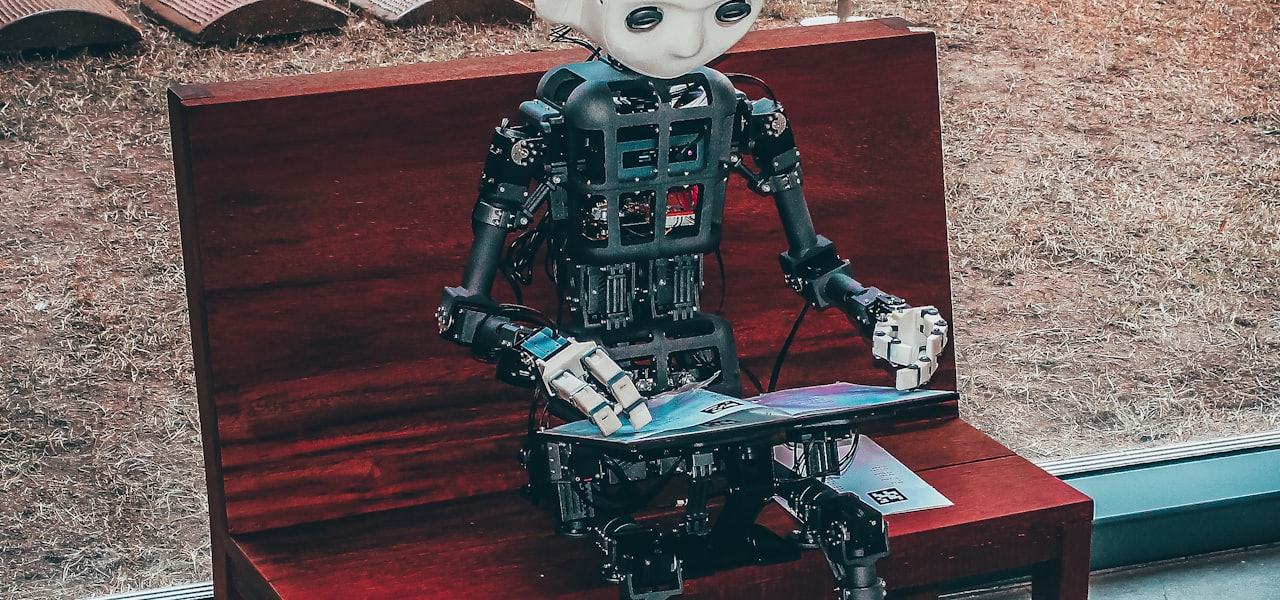
    Anthrobotics is the science of developing and studying robots that are either entirely or in some way human-like. The term anthrobotics was originally coined by Mark Rosheim in a paper entitled "Design of An Omnidirectional Arm" presented at the IEEE International Conference on Robotics and Automation, May 13–18, 1990, pp. 2162–2167. Rosheim says he derived the term from "...Anthropomorphic and Robotics to distinguish the new generation of dexterous robots from its simple industrial robot forebears." The word gained wider recognition as a result of its use in the title of Rosheim's subsequent book Robot Evolution: The Development of Anthrobotics, which focussed on facsimiles of human physical and psychological skills and attributes. However, a wider definition of the term anthrobotics has been proposed, in which the meaning is derived from anthropology rather than anthropomorphic. This usage includes robots that respond to input in a human-like fashion, rather than simply mimicking human actions, thus theoretically being able to respond more flexibly or to adapt to unforeseen circumstances. This expanded definition also encompasses robots that are situated in social environments with the ability to respond to those environments appropriately, such as insect robots, robotic pets, and the like. Anthrobotics is now taught at some universities, encouraging students not only to design and build robots for environments beyond current industrial applications, but also to speculate on the future of robotics that are embedded in the world at large, as mobile phones and computers are today. In 2016 philosopher Luis de Miranda created the Anthrobotics Cluster at the University of Edinburgh "a platform of cross-disciplinary research that seeks to investigate some of the biggest questions that will need to be answered" on the relationship between humans, robots and intelligent systems and "a think tank on the social spread of robotics, and also how automation is part of the definition of what humans have always been". to explore the symbiotic relationship between humans and automated protocols.

    Read more →
  • PCVC Speech Dataset

    PCVC Speech Dataset

    The PCVC (Persian Consonant Vowel Combination) Speech Dataset is a Modern Persian speech corpus for speech recognition and also speaker recognition. The dataset contains sound samples of Modern Persian combination of vowel and consonant phonemes from different speakers. Every sound sample contains just one consonant and one vowel So it is somehow labeled in phoneme level. This dataset consists of 23 Persian consonants and 6 vowels. The sound samples are all possible combinations of vowels and consonants (138 samples for each speaker). The sample rate of all speech samples is 48000 which means there are 48000 sound samples in every 1 second. Every sound sample starts with consonant then continues with vowel. In each sample, in average, 0.5 second of each sample is speech and the rest is silence. Each sound sample ends with silence. All of sound samples are denoised with "Adaptive noise reduction" algorithm. Compared to Farsdat speech dataset and Persian speech corpus it is more easy to use because it is prepared in .mat data files. Also it is more based on phoneme based separation and all samples are denoised. == Contents == The corpus is downloadable from its Kaggle web page, and contains the following: .mat data files of sound samples in a 23630000 matrix, in which 23 is number of consonants, 6 is the number of vowels and 30000 is the length of sound sample.

    Read more →
  • Adversarial machine learning

    Adversarial machine learning

    Adversarial machine learning is the study of the attacks on machine learning algorithms, and of the defenses against such attacks. Machine learning techniques are mostly designed to work on specific problem sets, under the assumption that the training and test data are generated from the same statistical distribution (IID). However, this assumption is often violated in practical high-stake applications, where users may intentionally supply fabricated data that violates the statistical assumption. Most common attacks in adversarial machine learning include evasion attacks, data poisoning attacks, Byzantine attacks and model extraction. == History == At the MIT Spam Conference in January 2004, John Graham-Cumming showed that a machine-learning spam filter could be used to defeat another machine-learning spam filter by automatically learning which words to add to a spam email to get the email classified as not spam. In 2004, Nilesh Dalvi and others noted that linear classifiers used in spam filters could be defeated by simple "evasion attacks" as spammers inserted "good words" into their spam emails. (Around 2007, some spammers added random noise to fuzz words within "image spam" in order to defeat OCR-based filters.) In 2006, Marco Barreno and others published "Can Machine Learning Be Secure?", outlining a broad taxonomy of attacks. As late as 2013 many researchers continued to hope that non-linear classifiers (such as support vector machines and neural networks) might be robust to adversaries, until Battista Biggio and others demonstrated the first gradient-based attacks on such machine-learning models (2012–2013). In 2012, deep neural networks began to dominate computer vision problems; starting in 2014, Christian Szegedy and others demonstrated that deep neural networks could be fooled by adversaries, again using a gradient-based attack to craft adversarial perturbations. Further work would show that adversarial attacks are harder to produce in uncontrolled environments, due to the different environmental constraints that cancel out the effect of noise. For example, any small rotation or slight illumination on an adversarial image can destroy the adversariality. In addition, researchers such as Google Brain's Nick Frosst point out that it is much easier to make self-driving cars miss stop signs by physically removing the sign itself, rather than creating adversarial examples. Frosst also believes that the adversarial machine learning community incorrectly assumes models trained on a certain data distribution will also perform well on a completely different data distribution. He suggests that a new approach to machine learning should be explored, and is currently working on a unique neural network that has characteristics more similar to human perception than state-of-the-art approaches. While adversarial machine learning continues to be heavily rooted in academia, large tech companies such as Google, Microsoft, and IBM have begun curating documentation and open source code bases to allow others to concretely assess the robustness of machine learning models and minimize the risk of adversarial attacks. === Examples === Examples include attacks in spam filtering, where spam messages are obfuscated through the misspelling of "bad" words or the insertion of "good" words; attacks in computer security, such as obfuscating malware code within network packets or modifying the characteristics of a network flow to mislead intrusion detection; attacks in biometric recognition where fake biometric traits may be exploited to impersonate a legitimate user; or to compromise users' template galleries that adapt to updated traits over time. Researchers showed that by changing only one-pixel it was possible to fool deep learning algorithms. Others 3-D printed a toy turtle with a texture engineered to make Google's object detection AI classify it as a rifle regardless of the angle from which the turtle was viewed. Creating the turtle required only low-cost commercially available 3-D printing technology. A machine-tweaked image of a dog was shown to look like a cat to both computers and humans. A 2019 study reported that humans can guess how machines will classify adversarial images. Researchers discovered methods for perturbing the appearance of a stop sign such that an autonomous vehicle classified it as a merge or speed limit sign. A data poisoning filter called Nightshade was released in 2023 by researchers at the University of Chicago. It was created for use by visual artists to put on their artwork to corrupt the data set of text-to-image models, which usually scrape their data from the internet without the consent of the image creator. McAfee attacked Tesla's former Mobileye system, fooling it into driving 50 mph over the speed limit, simply by adding a two-inch strip of black tape to a speed limit sign. Adversarial patterns on glasses or clothing designed to deceive facial-recognition systems or license-plate readers, have led to a niche industry of "stealth streetwear". An adversarial attack on a neural network can allow an attacker to inject algorithms into the target system. Researchers can also create adversarial audio inputs to disguise commands to intelligent assistants in benign-seeming audio; a parallel literature explores human perception of such stimuli. Clustering algorithms are used in security applications. Malware and computer virus analysis aims to identify malware families, and to generate specific detection signatures. In the context of malware detection, researchers have proposed methods for adversarial malware generation that automatically craft binaries to evade learning-based detectors while preserving malicious functionality. Optimization-based attacks such as GAMMA use genetic algorithms to inject benign content (for example, padding or new PE sections) into Windows executables, framing evasion as a constrained optimization problem that balances misclassification success with the size of the injected payload and showing transferability to commercial antivirus products. Complementary work uses generative adversarial networks (GANs) to learn feature-space perturbations that cause malware to be classified as benign; Mal-LSGAN, for instance, replaces the standard GAN loss with a least-squares objective and modified activation functions to improve training stability and produce adversarial malware examples that substantially reduce true positive rates across multiple detectors. == Challenges in applying machine learning to security == Researchers have observed that the constraints under which machine-learning techniques function in the security domain are different from those of common benchmark domains. Security data may change over time, include mislabeled samples, or reflect adversarial behavior, which complicates evaluation and reproducibility. === Data collection issues === Security datasets vary across formats, including binaries, network traces, and log files. Studies have reported that the process of converting these sources into features can introduce bias or inconsistencies. In addition, time-based leakage can occur when related malware samples are not properly separated across training and testing splits, which may lead to overly optimistic results. === Labeling and ground truth challenges === Malware labels are often unstable because different antivirus engines may classify the same sample in conflicting ways. Ceschin et al. note that families may be renamed or reorganized over time, causing further discrepancies in ground truth and reducing the reliability of benchmarks. === Concept drift === Because malware creators continuously adapt their techniques, the statistical properties of malicious samples also change. This form of concept drift has been widely documented and may reduce model performance unless systems are updated regularly or incorporate mechanisms for incremental learning. === Feature robustness === Researchers differentiate between features that can be easily manipulated and those that are more resistant to modification. For example, simple static attributes, such as header fields, may be altered by attackers, while structural features, such as control-flow graphs, are generally more stable but computationally expensive to extract. === Class imbalance === In realistic deployment environments, the proportion of malicious samples can be extremely low, ranging from 0.01% to 2% of total data. This unbalanced distribution causes models to develop a bias towards the majority class, achieving high accuracy but failing to identify malicious samples. Prior approaches to this problem have included both data-level solutions and sequence-specific models. Methods like n-gram and Long Short-Term Memory (LSTM) networks can model sequential data, but their performance has been shown to decline significantly when malware samples are realistically proportioned in the training set, demonstrating the limitations in

    Read more →
  • Image scaling

    Image scaling

    In computer graphics and digital imaging, image scaling is the resizing of a digital image. In video technology, the magnification of digital material is known as upscaling or resolution enhancement. When scaling a vector graphic image, the graphic primitives that make up the image can be rendered using geometric transformations at any resolution with no loss of image quality. When scaling a raster graphics image, a new image with a higher or lower number of pixels must be generated. In the case of decreasing the pixel number (scaling down), this usually results in a visible quality loss. From the standpoint of digital signal processing, the scaling of raster graphics is a two-dimensional example of sample-rate conversion, the conversion of a discrete signal from a sampling rate (in this case, the local sampling rate) to another. == Mathematical == Image scaling can be interpreted as a form of image resampling or image reconstruction from the view of the Nyquist sampling theorem. According to the theorem, downsampling to a smaller image from a higher-resolution original can only be carried out after applying a suitable 2D anti-aliasing filter to prevent aliasing artifacts. The image is reduced to the information that can be carried by the smaller image. In the case of up sampling, a reconstruction filter takes the place of the anti-aliasing filter. A more sophisticated approach to upscaling treats the problem as an inverse problem, solving the question of generating a plausible image that, when scaled down, would look like the input image. A variety of techniques have been applied for this, including optimization techniques with regularization terms and the use of machine learning from examples. == Algorithms == An image size can be changed in several ways. === Nearest-neighbor interpolation === One of the simpler ways of increasing image size is nearest-neighbor interpolation, replacing every pixel with the nearest pixel in the output; for upscaling, this means multiple pixels of the same color will be present. This can preserve sharp details but also introduce jaggedness in previously smooth images. 'Nearest' in nearest-neighbor does not have to be the mathematical nearest. One common implementation is to always round toward zero. Rounding this way produces fewer artifacts and is faster to calculate. This algorithm is often preferred for images which have little to no smooth edges. A common application of this can be found in pixel art. === Bilinear and bicubic interpolation === Bilinear interpolation works by interpolating pixel color values, introducing a continuous transition into the output even where the original material has discrete transitions. Although this is desirable for continuous-tone images, this algorithm reduces contrast (sharp edges) in a way that may be undesirable for line art. Bicubic interpolation yields substantially better results, with an increase in computational cost. === Sinc and Lanczos resampling === Sinc resampling, in theory, provides the best possible reconstruction for a perfectly bandlimited signal. In practice, the assumptions behind sinc resampling are not completely met by real-world digital images. Lanczos resampling, an approximation to the sinc method, yields better results. Bicubic interpolation can be regarded as a computationally efficient approximation to Lanczos resampling. === Box sampling === One weakness of bilinear, bicubic, and related algorithms is that they sample a specific number of pixels. When downscaling below a certain threshold, such as more than twice for all bi-sampling algorithms, the algorithms will sample non-adjacent pixels, which results in both losing data and rough results. The trivial solution to this issue is box sampling, which is to consider the target pixel a box on the original image and sample all pixels inside the box. This ensures that all input pixels contribute to the output. The major weakness of this algorithm is that it is hard to optimize. === Mipmap === Another solution to the downscale problem of bi-sampling scaling is mipmaps. A mipmap is a prescaled set of downscaled copies. When downscaling, the nearest larger mipmap is used as the origin to ensure no scaling below the useful threshold of bilinear scaling. This algorithm is fast and easy to optimize. It is standard in many frameworks, such as OpenGL. The cost is using more image memory, exactly one-third more in the standard implementation. === Fourier-transform methods === Simple interpolation based on the Fourier transform pads the frequency domain with zero components (a smooth window-based approach would reduce the ringing). Besides the good conservation (or recovery) of details, notable are the ringing and the circular bleeding of content from the left border to the right border (and the other way around). === Edge-directed interpolation === Edge-directed interpolation algorithms aim to preserve edges in the image after scaling, unlike other algorithms, which can introduce staircase artifacts. Examples of algorithms for this task include New Edge-Directed Interpolation (NEDI), Edge-Guided Image Interpolation (EGGI), Iterative Curvature-Based Interpolation (ICBI), and Directional Cubic Convolution Interpolation (DCCI). A 2013 analysis found that DCCI had the best scores in peak signal-to-noise ratio and structural similarity on a series of test images. === hqx === For magnifying computer graphics with low resolution and/or few colors (usually from 2 to 256 colors), better results can be achieved by hqx or other pixel-art scaling algorithms. These produce sharp edges and maintain a high level of detail. === Vectorization === Vector extraction, or vectorization, offers another approach. Vectorization first creates a resolution-independent vector representation of the graphic to be scaled. The resulting SVG vector file can then be exported and rendered at any required resolution without quality loss, serving directly as production-ready artwork for scalable display & printing. This technique is used by Adobe Illustrator, Live Trace, and Inkscape. Scalable Vector Graphics are well suited to simple geometric images, while photographs do not fare well with vectorization due to their complexity. === Deep convolutional neural networks === This method uses machine learning for more detailed images, such as photographs and complex artwork. Programs that use this method include waifu2x, Imglarger and Neural Enhance. Demonstration of conventional vs. waifu2x upscaling with noise reduction, using a detail of Phosphorus and Hesperus by Evelyn De Morgan. [Click image for full size] AI-driven upscaling software allows detail and sharpness to be added to historical photographs, where it is not present in the original. The availability of AI upscaling tools has led to confusion where a person believes that the upscaled version of a blurry image is genuinely showing them the subject of the original photograph. In 2025 a user of the social media site X posted an AI-upscaled version of a low resolution photo of Donald Trump that they had zoomed in on, and asked if anyone could "explain what the hell is happening to his forehead". Experts noted that the image had been distorted by the upscaling process, and that such tools "inevitably have to invent, or at least recreate, details that were or were not there". == Applications == === General === Image scaling is used in, among other applications, web browsers, image editors, image and file viewers, software magnifiers, digital zoom, the process of generating thumbnail images, and when outputting images through screens or printers. === Video === This application is the magnification of images for home theaters for HDTV-ready output devices from PAL-Resolution content, for example, from a DVD player. Upscaling is performed in real time, and the output signal is not saved. === Pixel-art scaling === As pixel-art graphics are usually low-resolution, they rely on careful placement of individual pixels, often with a limited palette of colors. This results in graphics that rely on stylized visual cues to define complex shapes with little resolution, down to individual pixels. This makes scaling pixel art a particularly difficult problem. Specialized algorithms were developed to handle pixel-art graphics, as the traditional scaling algorithms do not take perceptual cues into account. Since a typical application is to improve the appearance of fourth-generation and earlier video games on arcade and console emulators, many are designed to run in real time for small input images at 60 frames per second. On fast hardware, these algorithms are suitable for gaming and other real-time image processing. These algorithms provide sharp, crisp graphics, while minimizing blur. Scaling art algorithms have been implemented in a wide range of emulators such as HqMAME and DOSBox, as well as 2D game engines and game engine recreations such as ScummVM. They gained recognition with game

    Read more →
  • Vegas Pro

    Vegas Pro

    Vegas Pro (formerly known as Sony Vegas) is a professional video editing software package for non-linear editing (NLE), designed to run on the Microsoft Windows operating system. The first release of Vegas Beta was on June 11, 1999. Vegas was originally developed as a non-linear audio editing application. Version 2.0 would split the program into audio and video editing variants, with the former being dropped by version 4.0, making the video offering the only variant available to consumers. Vegas Pro features real-time multi-track video and audio editing on unlimited tracks, resolution-independent video sequencing, complex effects, compositing tools, 24-bit/192 kHz audio support, VST and DirectX plug-in effect support, and Dolby Digital surround sound mixing. The software was originally published by Sonic Foundry until May 2003, when Sony purchased Sonic Foundry and formed Sony Creative Software. On May 24, 2016, Sony announced that Vegas was sold to MAGIX, which formed VEGAS Creative Software, to continue support and development of the software. As of the end of March 2026, it was publicly announced that Boris FX had taken ownership of Vegas Pro. Each release of Vegas is sold standalone; however, upgrade discounts are sometimes provided. == Features == Vegas does not require any specialized hardware to run properly, allowing it to operate on any Windows computer that meets the system requirements. == History == Vegas 1.0 was released after a brief public beta by Sonic Foundry on July 23, 1999 at the NAMM Show in Nashville, Tennessee as an audio-only tool with a particular focus on re-scaling and resampling audio. It supported formats like DivX and Real Networks RealSystem G2 file formats. Martin Walker from Sound on Sound described working in Vegas 1.0 as a "very pleasurable experience, especially since so many functions are highly intuitive" though also criticizing some features as hard to figure out due to the lack of a central help file. Later, on June 12, 2000, Vegas Video and Audio 2.0 (also referred to as just Vegas 2.0) was released, with its beta releasing earlier that year on April 10. This was the first version of Vegas to include video-editing tools and was also the first to have a low-cost "LE" version alongside the regular release. The LE releases would continue through version 3.0 of Vegas but would be discontinued by the release of Vegas 4.0. Vegas 3.0 was released the next year on December 3, and added new video effects, features for ease-of-use with DV, and support for editing Windows Media files. Vegas 4.0 was released on 6 February 2003 and added application scripting, advanced color correction, 5.1 surround sound mixing, and Steinberg ASIO support. This was the last release under the Sonic Foundry name after it sold much of its software suite, including Sound Forge and Acid Pro, to Sony Pictures Digital for $18 million later in 2003. Under Sony's ownership, Vegas 5.0 was released on April 19, 2004, bringing 3D track motion, compositing, reversing, envelope automation, etc. 7.0 also added an improved video preview, enhanced layout management, improved snapping, and more customization. With the release of 8.0, Sony opted to go back to the original "Vegas Pro" branding that the first version released with. It added the ability to burn Blu-ray and DVD optical media, support for 32-bit floating point audio, support for tempo-based audio effects, and more. It also moved the timeline to the bottom of the window by default with the option of moving it back to the top if the user wished to. Sony was also experimenting with 64-bit at this time and ported Vegas Pro 8.0 to 64-bit systems under the name "Vegas Pro 8.1". Vegas Pro 9.0 added support for 4K resolution and pro camcorder formats like Red and XDCAM EX. In 2009, Sony Creative Software purchased the Velvetmatter Radiance suite of video FX plug-ins which were included in Sony Vegas Pro 9.0. As a result, they were no longer available as a separate product from Velvetmatter. Vegas Pro 10 was released in 2010 with stereoscopic 3D editing, image stabilization, OpenFX plugin support, real-time audio event effects, and a few UI changes. This was the last release to include support for Windows XP. Vegas Pro 11 was released the next year on 17 October, with GPGPU video acceleration, enhanced text tools, enhanced stereoscopic/3D features, RAW photo support, and new event synchronization mechanisms. In addition, Vegas Pro 11 comes pre-loaded with "NewBlue" Titler Pro, a 2D and 3D titling plug-in. Vegas Pro 12 would add two new configurations: Vegas Pro 12 Edit, for "Professional Video and Audio Production"; and Vegas Pro 12 Suite, for "Professional Editing, Disc Authoring, and Visual Effects Design". Vegas Pro 13 would be the last version released with Sony branding after the acquisition of much of Sony Creative Software's library by Magix. After they acquired Vegas, Magix released version 14 on September 20, 2016. It featured advanced 4K upscaling as well as many bug fixes, a higher video velocity limit, RED camera support, and a variety of other features. This was also the last version to have the light theme enabled by default. Released on August 28, 2017, Vegas Pro 15 features major UI changes that claim to bring usability improvements and customization. It was the first version of VEGAS Pro to have a dark theme; it also allows more efficient editing speeds, including adding new shortcuts to speed the video editing process. Vegas Pro 15 includes support for Intel Quick Sync Video (QSV) and other technologies, as well as various other features. It introduced a new VEGAS Pro icon as a V. Vegas Pro 16 has some new features including file backup, motion tracking, improved video stabilization, 360° editing and HDR support. Magix has continued to improve Vegas through version 21 with support for reading Matroska files, a more detailed render dialogue, live streaming, VST3 support, a VST 32-bit bridge, and a selective Paste Event Attributes menu. Magix would later release a subscription model for using Vegas named "Vegas Pro 365" on January 17, 2018, although the perpetual licence is still an option for customers. This version includes cloud-based speech synthesis among other features not included in the mainline Vegas release. == Version history == Each release of Vegas is sold standalone, however upgrade discounts are sometimes provided. === Vegas Beta === Sonic Foundry introduced a sneak preview version of Vegas Pro on June 11, 1999. It is called a "Multitrack Media Editing System". === Vegas 1.0 === Released on July 23, 1999 at the NAMM Show in Nashville, Tennessee, Vegas was an audio-only tool with a particular focus on rescaling and resampling audio. It supported formats like DivX and Real Networks RealSystem G2 file formats. Version 1.0 is the final Vegas release to include Windows 95 support. === Vegas Video beta (Vegas 2.0 beta) === Released on April 10, 2000, this was the first version of Vegas to include video-editing tools. === Vegas Video (Vegas 2.0) === Released on June 12, 2000. Version 2.0 is the final Vegas Video release to include Windows NT 4.0 support. === Vegas Video 3.0 === Released on December 3, 2001. This release added: New Video Effects – Lens Flare, Light Rays, Film FX, Color Curves, Mirror, Remap, Deform, Convolution, Linear Blur, Black Restore, Levels, Unsharp Mask, Color Grading, and Timecode Burn filter. Batch Capture with Automatic Scene Detection – Captures DV with automatic scene detection, batch capture, tape logging, still image capture and thumbnail previews. Red Book Audio CD Mastering with CD Architect (TM) Technology – Used for burning Red Book audio CD masters directly from the Vegas timeline with ISRC, UPC, and PQ list support. New Sonic Foundry DV Codec – Introduces a DV codec developed by Sonic Foundry that offers artifact-free compositing and DV chromakeying. DV Print-to-Tape from the Timeline – Prints projects to DV cameras and decks from the Vegas timeline. Windows Media (TM) File Editing – Creates and edits Windows Media (TM) files. New MPEG Encoding Tools – Used for producing MPEG-2 files for DVD productions. Dynamic RAM Previewing – Temporary RAM/render-free previews for analysis and tweaking of complex video FX without rendering. VideoCD and Data CD Burning – Burning projects directly to VideoCD for playback on most DVD players or data CDs for playback computers' CD-ROMs. === Vegas 4.0 === Released on February 6, 2003. This release added: Advanced Color Correction Tools Searchable Media Pool Bins Vectorscope, Histogram, Parade and Waveform Monitoring Application Scripting Improved Ripple Editing Motion Blur and Super-Sampling Envelopes 5.1 Surround Mixing Dolby® Digital AC-3 Encoding certified and tested by Dolby Laboratories DirectX® Audio Plug-In Effects Automation ASIO Driver Support Windows Media™ 9 Support, including Surround Encoding DVD Authoring with AC-3 File Import Capabilities Integration with DVD Architect via Chap

    Read more →